Biography
Joshua Nierodzinski (b. 1982, Worcester, MA, USA) is a visual artist and co-founder of HEKLER. His studio practice reimagines American history and identity through a visual language that merges oil painting with multispectral photography. Raised in a working class family, Nierodzinski explores the complexities of value, hierarchy, and belonging. His paintings incorporate references to personal experience and collective history which he merges into allegorical compositions. The result is a multilayered body of work that addresses the connections between literal truth and symbolic meaning.
Nierodzinski earned his BFA in Painting and Art History from the University of Massachusetts Dartmouth and his MFA from the University of Michigan Ann Arbor. His work has been exhibited nationally and internationally with solo presentations in the U.S. and Mexico. He is the recipient of a National Endowment for the Arts Grant and an AIM Bronx Museum Fellowship among others.
Artist Statement
When I was a child, I wanted to be a spy.
During a family trip to Washington D.C., we went to CIA headquarters to see the famous marble lobby. On the right side, there was an exhibition space with cryptographic machines from WWII. I didn’t know how they worked but I sensed that they were enchanted objects. Around the same time, Tyco released a line of toys called SpyTech that included a fingerprint dusting kit. Spytech taught me that espionage was not just about breaking codes but also involved forensics. Using clues to build a case, to make a convincing story, to paint a vivid picture.
Fast forward to my first year as a graduate student, I encountered a research paper by Peter Paul Biro titled, Forensics and Microscopy in Authenticating Works of Art. Biro was the first forensic art analyst to successfully verify the work of J.M.W. Turner using the artist’s fingerprints. His pioneering work merged the fields of art, forensic science, and historical study. It inspired me to reexamine my practice.
With the help of the Williamstown Art Conservation Center, I developed a method to combine oil painting with multi-spectral photographic techniques like X-rays, infrared, and ultraviolet light. While conservators typically use these techniques to authenticate artwork, I believed I could use them to interrogate authenticity itself, as it pertains to identity, history, and justice. It’s no secret that history is full of cover-ups and deception. It was important for me to develop a visual language that can reveal truths.
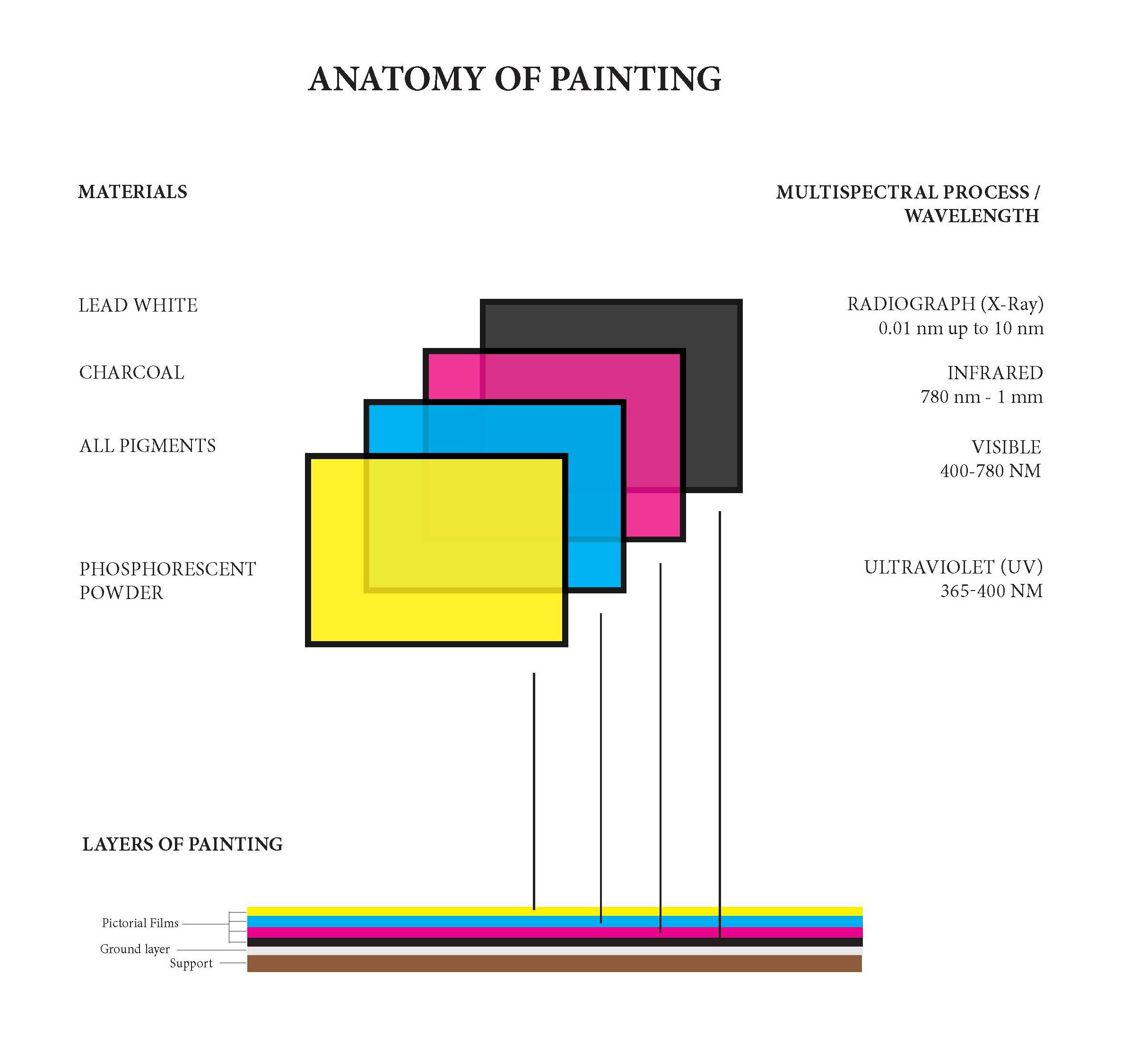
I begin my creative process with research, drawing, and digital collages to compose a painting with four distinct image layers. Each layer is covered by the next or is invisible to the naked eye. When the painting is finished, I expose it to the multi-spectral imaging mentioned earlier and sequence the photographs into a video. Working this way transforms the films of paint into frames, like a flashback or jump cut. This kind of imaginative viewing is similar to the reconstruction of events during a legal trial where the goal is to present evidence and offer interpretations. The video also serves as a Certificate of Authenticity (COA) that is cryptographically minted as a smart contract. The COA can be accessed with a phone by scanning a Near-Field Communicator (NFC) transmitter on the back of the painting.
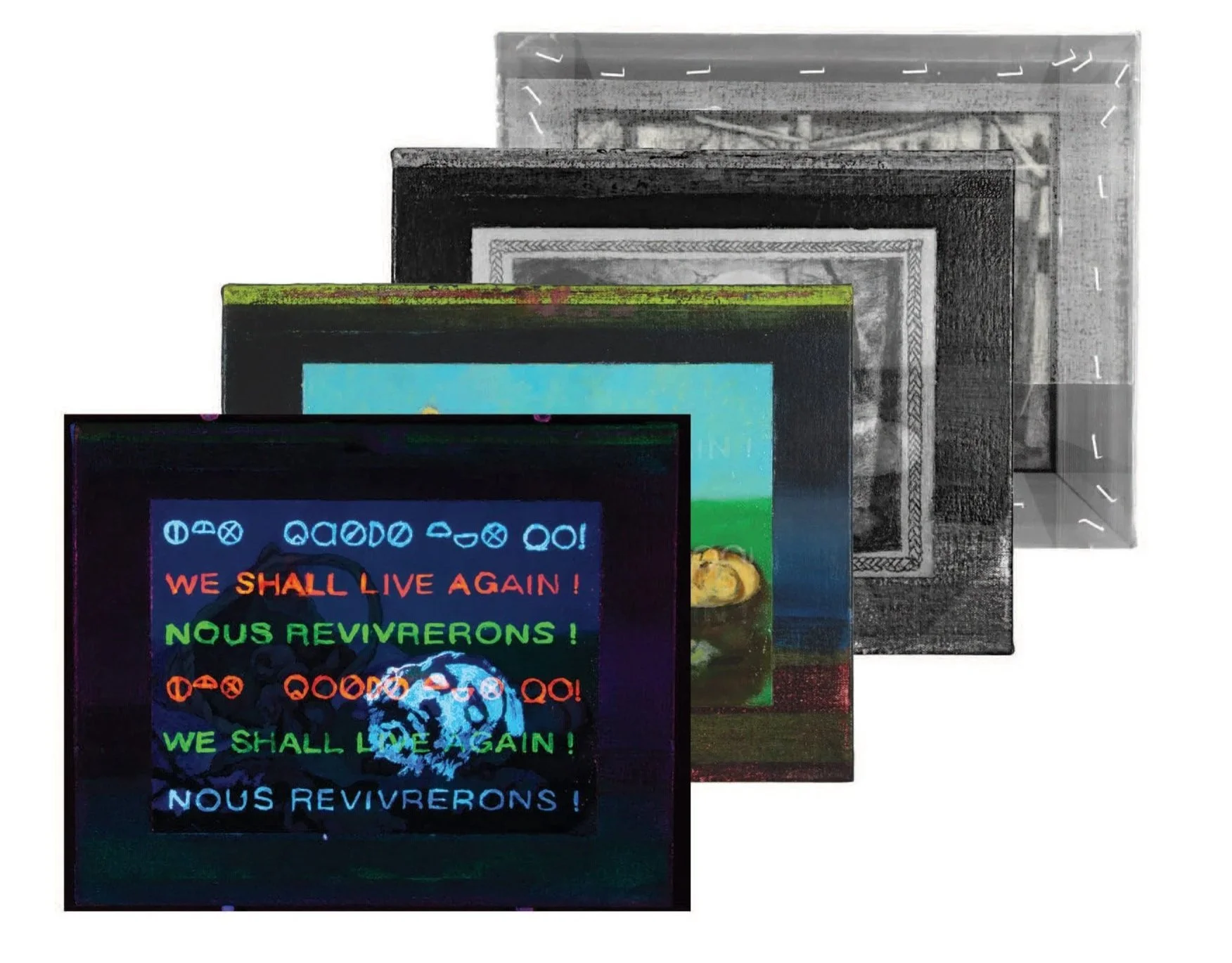
Ultraviolet, Visible, Infrared and X-ray photographs showing layers of the painting, We Shall Live Again! (1862).
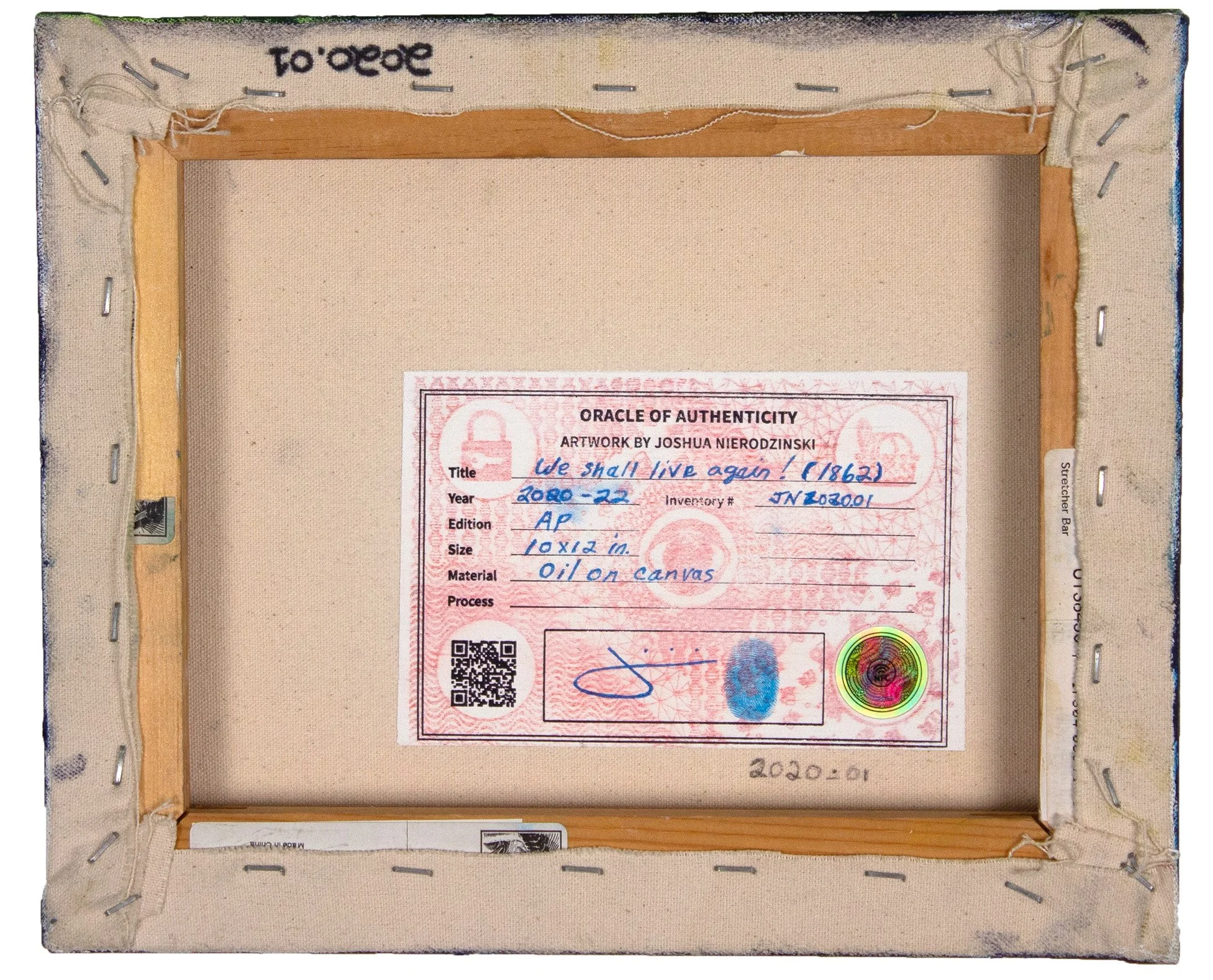
Verso of the painting, We Shall Live Again! (1862), showing Stamp of Authenticity and NFC tag.
My images often merge events in US history and culture with my personal experience. I was raised in a working class immigrant family concerned with kitchen table issues, social hierarchies, and national identity. I want to understand my position and relation to all people involved with, and affected by, the American experiment. My studio practice enables me to do this while preserving the past, interpreting the present, and speculating about the future. So, even though I never became a spy, I found a better way to carefully observe our world.