Biography
Joshua Nierodzinski (b. 1982, Worcester, MA, USA) is a visual artist and co-founder of HEKLER. His studio practice reimagines American history and identity through a visual language that merges oil painting with multispectral photography. Raised in a working class family, Nierodzinski explores the complexities of value, hierarchy, and belonging. His paintings incorporate references to personal experience and collective history which he merges into allegorical compositions. The result is a multilayered body of work that addresses the connections between literal truth and symbolic meaning.
Nierodzinski earned his BFA in Painting and Art History from the University of Massachusetts Dartmouth and his MFA from the University of Michigan Ann Arbor. His work has been exhibited nationally and internationally with solo presentations in the U.S. and Mexico. He is the recipient of a National Endowment for the Arts Grant and an AIM Bronx Museum Fellowship among others.
Artist Statement
My interdisciplinary creative practice examines value judgments in culture. Why are some people celebrated while others are condemned, or forgotten? What stories, myths, or historical events are used to teach lessons or define identity? The answers require looking past surface behaviors to the underlying beliefs that define what a society considers good, bad, important, or taboo. I embody this dynamic in my mutli-layered painting practice that blends traditional oil painting techniques with multi-spectral photography.
I start from the position that painting is an image-object that denotes aesthetic, financial, and sociological value. All forms of painting, including expanded notions, must negotiate within this context. However, as art historian Isabelle Graw notes in The Love of Painting, “[a] kind of painting that repudiates its supposed essence will always be preferable to one that keeps within its allotted boundaries and has unbroken faith in itself.” In order to investigate the essence and boundaries of painting, I borrow concepts and methodologies from forensic science, art conservation, and media studies. Artist and researcher, Susan Schuppli, writes about the operative concept of material witness, how media objects collect evidence in addition to their roles as cultural transmitters. The pigments and materials that constitute a painting are in constant dialogue with the environment and retain information about their contact that may not be visible to the naked eye. Forensic art analysts have developed ways of collecting and analyzing that information with multispectral photographic methods such as X-rays, infrared, and ultraviolet light. I synchronize these specific materials and techniques through methodical application into allegorical paintings.
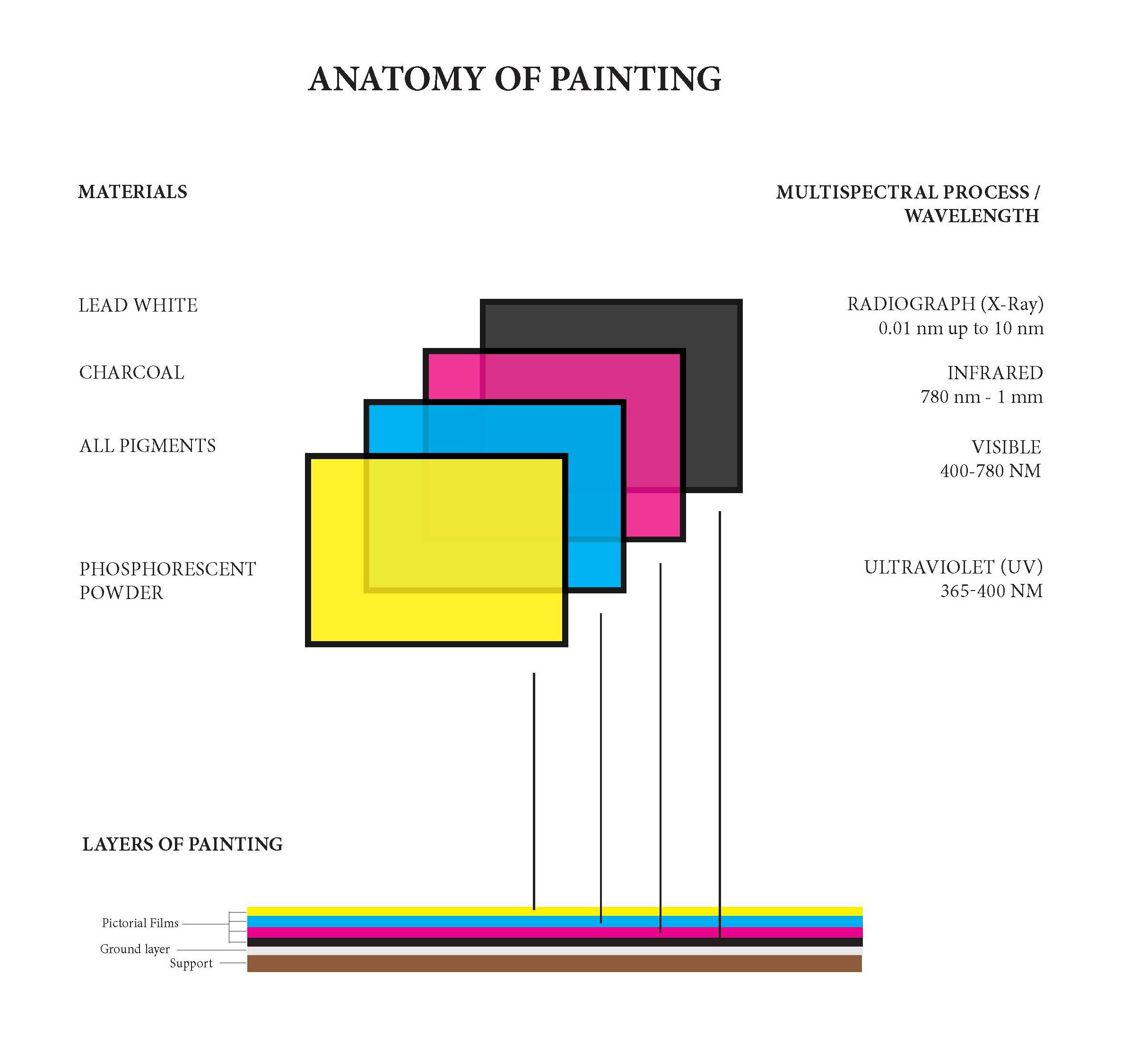
I begin my creative process with research, drawing, and digital collages to compose a painting with four distinct image layers. Each layer is covered by the next or is invisible to the naked eye. When the painting is finished, I expose it to the multi-spectral imaging mentioned earlier and sequence the photographs into a video where the films of paint to behave like frames in a flashback or jump cut. I liken this way of viewing is what Matthew Kirschenbaum, a professor of English and Digital Studies at University of Maryland, College Park, defines as forensic imagination; an interpretive mode of inquiry that treats physical and digital evidence as a narrative clue to reconstruct past events or create new ones. The video also serves as a Certificate of Authenticity (COA) that is cryptographically minted as a smart contract. The COA can be accessed with a phone by scanning a Near-Field Communicator (NFC) transmitter on the back of the painting.
Just Deserts (2020-23) illuminated by black light reveals the repeated phrase, “Make The Law, Brek The Law”. The text hovers above a reinterpretation of Sobremesa - Dessert, by Brazilian performance artist and crime scene investigator, Berna Reale. Viewing the under layers of the painting reveals documentary photography of 1960s American Civil Rights Sit-ins by Fred Blackwell and video stills from CCTV of a 2014 police assault in Providence RI. The images condemn the impunity that police often enjoy after committing acts of state violence while the survivors are left without justice being served. Why this behavior is being rewarded? Is this really what we value?